The answers come from the people
May 27, 2026 | Adam Hollowell
On Monday Pope Leo XIV released Magnifica Humanitas, his first papal encyclical, on artificial intelligence. The document is broad and synoptic, but I want to focus here on a single concept, subsidiarity, and its function in the encyclical’s critique of AI.
Leo XIV describes subsidiarity as the principle that “whatever can be carried out by individuals, families, intermediary organizations, and local communities should not be carried out by higher-level authorities.” Decision-making belongs as close as possible to the people whose lives are impacted by those decisions, subsidiarity holds, and higher authorities find their purpose in the support of lower, community-based authorities. First formulated systematically in Quadragesimo Anno, Pope Pius XI’s 1931 encyclical, subsidiarity is a distinctively Catholic term. The idea, however, is ecumenical — “the answers come from the people,” for instance, was the working motto of the Highlander Folk School in the 1930s and 40s.
The innovation of Magnifica Humanitas is Leo XIV’s application of the principle of subsidiarity not to the higher-level authority of the state or the church, but to the AI companies quickly amassing de facto power over everyday life. Companies that monopolize expertise, data, and decision-making authority in artificial intelligence should, according to subsidiarity, “be directed toward the common good with transparency, accountability, and meaningful forms of participation.”
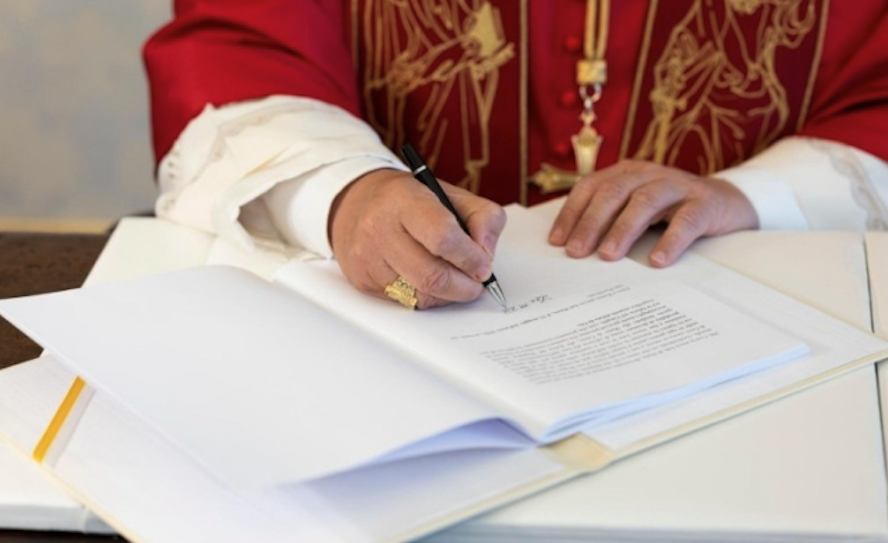
Image copyright: Vatican Media 2026
Chris Olah, interpretability lead at Anthropic, was invited to speak at the presentation of the encyclical in Vatican City on Monday. Two concerns in his published remarks are relevant to this theme: first, our duty to the global poor as AI displaces human labor, and second, the need for outside critics who are “willing to say hard things.”
These concerns are correct, but they remain, in Olah’s remarks, distinct. Held separately, the global poor will be objects of our compassion but not the authors of words we must heed. We risk hearing criticisms only from those with the credentials, influence, or pope-like authority to command our attention.
We should connect Olah’s concerns. In fact, the principle of subsidiarity requires that we do so.
It won’t be easy. “The answers come from the people” does not mean “the people are always right,” just as democracy and populism are not the same thing. Magnifica Humanitas aims to point us in the more fruitful of these directions by linking subsidiarity with solidarity: “When subsidiarity is not linked to solidarity, it ends up becoming merely the protection of particular interests; when solidarity is not supported by subsidiarity, it degenerates into a form of welfare that does not foster responsibility.” The appropriate combination is achieved through shared decision-making. It’s what Leo XIV calls the responsibility of authentic participation.
Anthropic has engaged collective critique in the past: In 2023, working with the Collective Intelligence Project, Anthropic ran a public input process with about a thousand Americans to draft an alternative constitution for an AI system. The resulting model scored lower on bias across multiple social dimensions, by Anthropic's own measure. Still, engaging critique is not the same as heeding it: among the public principles that did not match with Anthropic’s constitution in 2023 was “Choose the response that is most understanding of, adaptable, accessible, and flexible to people with disabilities.” Claude’s most recent constitution, released in 2026, does not express this principle. The public recommendation didn’t take.
I'd like to see Anthropic do more of this kind of work. Not work that keeps the global poor on one side and the insightful critics on the other, but that attends to both the needs and the opinions of those most impacted by transformative artificial intelligence. Work that advances subsidiarity and solidarity in tandem.
Magnifica Humanitas has a name for this: authentic participation.